
Maybe So Maybe Not

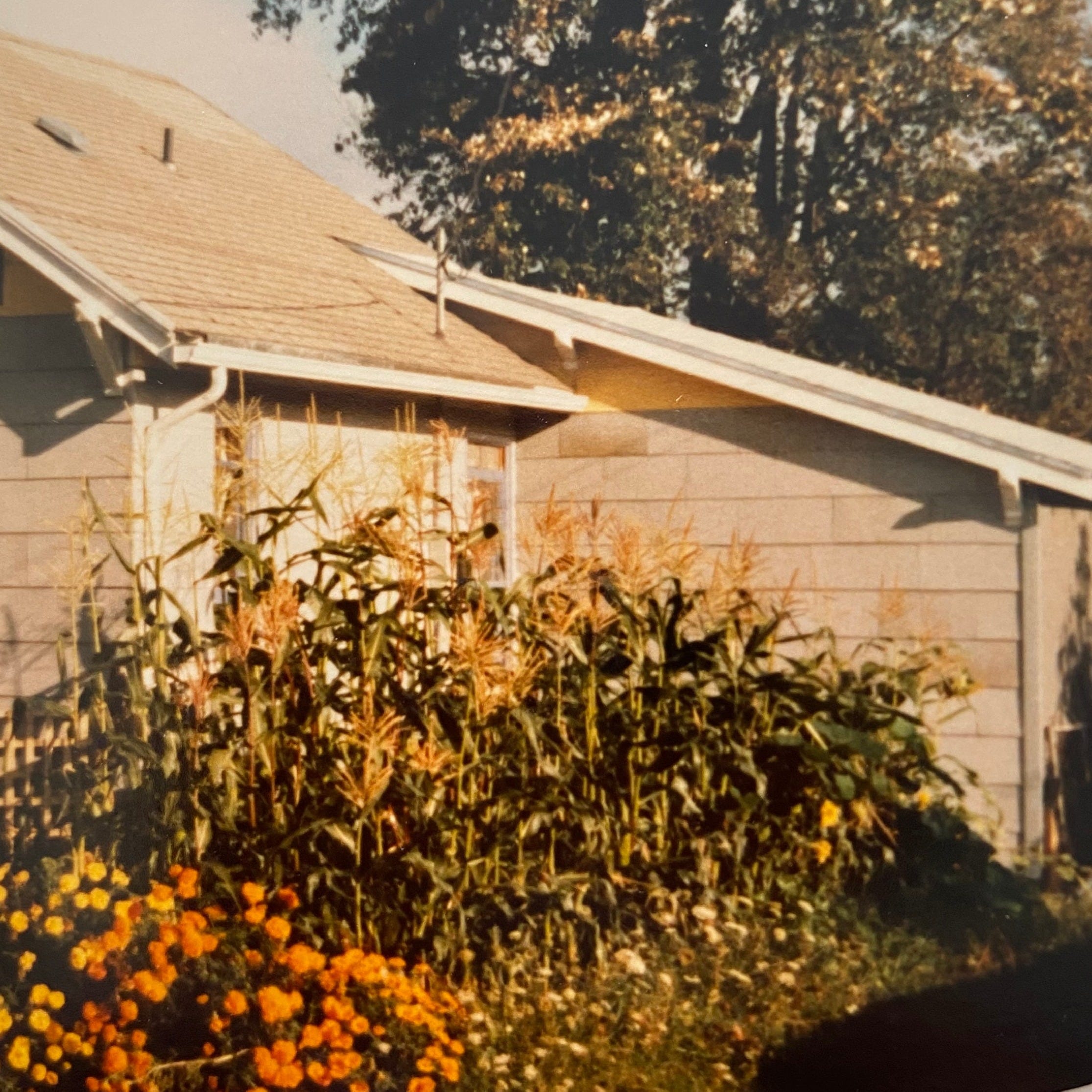
The first summer after we moved into our little house on Buffalo Street in Portland, Oregon, I grew corn and marigolds in what had been the driveway. This was the little house that became a rambly bigger house—the one where we just turned the basement staircase around to remodel it.

Eight years after we bought the house, Mark and I moved out of state and rented it out, hoping to come back some day. But once we were approaching retirement age, we realized that, with no bedroom on the ground floor, the house was not aging-friendly. We agreed the time had passed, we would never live there again. So I contacted an agent friend, and she found a developer interested before even putting it on the market. The implication was that he wanted the extra big lot and would “scrape” the house and build a McMansion.
I woke up one morning and realized I couldn’t do it. Mark’s fingerprints were on every square inch of that house. And my brain power was in every design. The house was like an extension of ourselves. We’d bought it as the plainest, most non-descript 20 x 30 house—you couldn’t even have called it a bungalow, as much as Portlanders like bungalows. And it was anything but a Craftsman, even though it was built in 1928, when Craftsman bungalows of every size were popping up all over North and Northeast Portland. It had really been just four walls and a roof before we remodeled the heck out of it.
I called my friend and cancelled the sale. You’re not supposed to do that. She was politely upset with me.
There was just something sweet about that house when Mark and I finished remodeling it. One of our kids was born there. We moved into a motel for several days so my sister could also give her second child a home birth in our home (near a Kaiser hospital).
Our daughter lived in the house with roommates during college, and when she married, she and her husband stayed on. When they moved out, one of the former roommates moved in with her husband and three little girls. Later, that friend also wanted to buy it from me. Everyone who ever lived there wanted to go on living there. That house and its big side yard held a happy life-force. You don’t easily sell a house like that.
As much as I’ve learned about variance, my mind still wants to make the house’s strange story coherent—maybe all the bad house luck that came around in the end was my punishment for taking it off the market when I had a buyer ready to go. (I was raised on the idea that God punishes bad behavior.)

Here’s the thing: regret for me is a powerful drug. Even remembering something I regret, I get worked up. My mind lavishly supplies video footage for the alternate universe in which, for example, I had not married this man but that. And I certainly never snapped at this man or that, but kindly, gently said what I had to say. I was always wiser, smarter and more beautiful in that universe, where I get to do-over my moments of lesser wisdom. Regret for the universe I’m in can always pull me under.
I’ve never managed the calm of the proverbial Chinese farmer. When his horse ran away, his neighbors all came to commiserate. “Such bad luck,” they said.
“Maybe so, maybe not,” said the farmer.
One day, he woke up to find the horse back in the paddock, and with it had come a beautiful wild mate.
“Such good luck!” the neighbors said.
“Maybe so, maybe not.”
The farmer’s son tried to ride the new horse, but he was thrown and broke his leg.
The neighbors shook their heads. “Bad luck, bad luck.”
“Maybe so, maybe not.”
The next week, war broke out on the border and the army came through, conscripting all able-bodied young men. The boy, with his broken leg, was left behind. Was that good luck or bad? Anyone who’s been the parent of an immobilized teen-ager knows that’s a real toss-up.
The wondrous and annoying universe throws so much stuff at me, I can’t tell when my luck is good or bad. Am I foolish or wise? Do I make good decisions or bad? It’s so hard to tell. Sometimes I can’t bear not knowing.
I’m not alone in that. Massive religious ceremonies have been organized around piercing the veil of the future so that people can choose rightly. Prophets and priestesses read entrails. There are tea leaves and fortune cookies, tarot cards, astrology and five-year plans. They comfort us in the moment of our insecurity.
In Lisa Feldman Barrett’s book Seven and a Half Lessons About the Brain there’s a chapter on how we cope with anxiety over having to step into the future with such frightening blindness. We try to domesticate the unknown by imaging it. But Barrett calls that remembering the future. Every future we imagine for ourselves is a memory of the past, she says.
That’s shocking. But of course. All the information our brains have comes from what we’ve experienced. We people our imagined future with people we already know. This includes ourselves. Those familiar people react in familiar ways to familiar events. The stories comfort us because they’re variations on lives we’ve already successfully lived. We feel at home.
Many nights I’ve lain awake, telling a story about the stress I could have saved myself if I had sold the house on Buffalo Street when I had the chance. The fun trips I could have taken with that money before Covid, when the world was safe and open. The new dining room rug I could have bought. The new cashmere sweater. Should I have sold? Maybe so. Maybe not.
And I must add, I’ve been through seven decades of clinging to lovely stories about my upcoming future. I’ve noticed that the stories never work out. It’s starting to make me crochety.