
Don't Say Just
A Tip for Remodeling Collaborations

I had the good fortune of marrying Mark, a man who could fix anything. This allowed me to remodel every old house I have lived in. I did not have the financial fortune it takes to pay for all that work. I, myself, had none of the practical, hands-on skills to do this. But Mark did.
Mark was always a loner. He loved best what he called dinking around alone in his workshop. And he hated taking orders from anyone. So working for himself as a handyman-remodeling-contractor was an ideal career path. And the adage, The children of the shoemaker go barefoot did not hold true in our family.
Mark had learned his skills from his dad, who started out as a builder and then cycled through seminary followed by med school. He bore boys with amazing skills. One became a luthier and built ornately inlaid guitars. Another went to both Peabody and Julliard to study piano. And there was Mark, who took apart every watch, typewriter and car he ever owned. When he was about ten, he found his dad’s old electric shaver in the trash, attached a propellor, and mounted it on a Dinky car. He called his brothers to watch. He plugged it in. The car zoomed across the floor until it popped the plug out of the wall. The little boys fell on the floor laughing, and screamed, “Again! Again!”
When he was 18, Mark’s mom and dad moved their family of six into a two-bedroom home with good bones. Mark’s dad pinged a line around the perimeter of the attic knee wall. As he went off to rounds in their small-town hospital, he left Mark as the construction foreman for the crew that was his brothers. Mark followed that yellow chalk line with a reciprocating saw and cut the house apart. His dad rented pneumatic jacks. Mark and his brothers lifted the top of the house, framed up the space, installed windows, doors and plumbing. Voila, two more bedrooms and another bath built by high school boys.
Ten years later, Mark and I bought our first house. It had one bedroom and we think it began life as a hunting shack in the woods north of Portland, Oregon. It sat unevenly on posts. Mark set a marble in the center of the living room floor.
“Watch this,” he said. The marble rolled to a corner, picking up speed as it went.
The bathroom had clearly been added later and appeared to attach to the house with masking tape. But we could afford it, at $17,000.
Within a year, Mark had decided to add a bedroom and proper bathroom. He first used that same kind of pneumatic jack to lift the whole house, so he could add a foundation. He spent days wriggling on his elbows in the dust under the house, shimming the corners. Every time he got two corners level, the third slipped and the house sagged again.
I could hear him swearing under the house. He came in day after day, filthy from head to toe. Every day he said, “Never. Never again am I building a house from the top down.”
In the end, Mark won and the saggy old floor joists straightened up. The result was a cute little two-bedroom house for us and our two preschool kids. But just when he got the final coat of paint on the new bedroom, I saw a different cute little house for sale on Buffalo Street. On a lot and a half, it had a big yard that would be perfect for the children to run around in. It had fruit trees, and space for me to plant an urban garden.
Mark couldn’t believe I would ask him to move after all the work he’d done.
“I need to rest! I need to enjoy this!” he said. But even he had to admit that the chance was too good to pass up. Maybe the apple tree convinced him. He must have seen immediately that its twin trunks would hold a two-story treehouse, where he and his kids could stage green apple fights. So I promised away the right to ever again initiate a move, and we sold our first house for $30,000.
A few years later, Mark hired a couple of neighborhood teen agers to help him dig out the unfinished basement and add two bedrooms and a second bath. The house was still cramped—the table barely fit in the kitchen, and I had to squeeze past it to stand at the sink. But the yard—it was so perfect! I didn’t mind.
And Mark wasn’t finished. A year after he finished the basement, he was ready for a new project. He pulled down the attic ladder and poked around up there. He got graph paper. He figured out how big a section of the roof he could cut out and raise with those handy pneumatic jacks. He said we could frame up walls, order trusses, and pop up a master bedroom on the second floor. The one problem he couldn’t figure out was the staircase.
A staircase is complicated. There’s the rise—the height of the steps, and they have to all be even. There’s the run—the width of the treads. Also even. And when you get that all figured out, do you still have headroom at the top? We sketched a staircase rising out of the kitchen—the kitchen was already too small. We sketched a staircase out of our bedroom—but where would we squeeze in the bed? And who wants to troop through a bedroom to get upstairs? The layout for a staircase didn’t work in our tiny 600 square feet, no matter how we messed with it.
Until one morning, I woke up with the solution fully envisioned. I shook my sleeping husband’s shoulder. “Mark! I’ve got it!”
He mumbled and rolled over toward me, eyes closed.
“We can get upstairs if we flip the kitchen and bedroom.” This sounds dramatic, but I knew it would be no problem for Mark. He nodded. “Then just turn around the staircase to the basement!”
Mark lay there, thinking it through. Then, eyes still closed, he spoke slowly. “You’re right. That will work. But please. When you’re talking about moving a staircase, don’t say just.”
It worked. Whether it was foundations built after the house, or staircases turned around, Mark could do it. And even though he is gone now, he’s left behind a new adage—don’t say just
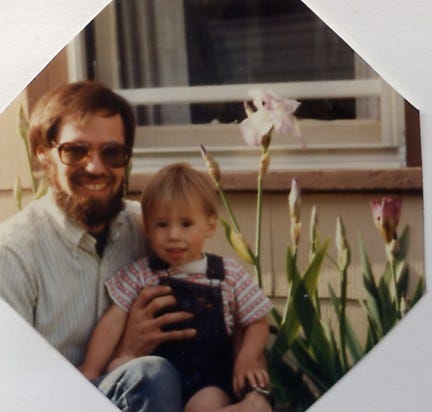
Mark and Jesse, 1982, in front of the irises I planted along the foundation he so patiently built under our first house.
Bravo you for seeing the fix, and Mark for his amazing gifts.
What a great story, Caroline!